i was just surveying some cameras that i picked up , german made of course, in the 1950's and came to realise that they are rather nice pieces of engineering exellence.
One of my favorites is the Praktiflex, complete with waist level finder. They are very sharp cameras! for all the new fandangled innovations , i don't mind using the old chrome clunkers. they are heavy, old ,but still in some situations outperform modern cameras. I must say that most of the 1950 cameras i have are a lot quieter than my Pentax *isd... thanks to the fact they are rangefinders with leaf shutters.
I think i can see a new habit forming....the slow aquisition of dinosaur cameras.....
Monday, March 05, 2007


Sunday, March 04, 2007
Zone Focus vs Range Focus


Well this nifty little thing is not a prop from a recent Star Wars movie but a rangefinder attachment for Zone Focus cameras.. making life a little easier to get the 'correct' focus. The question arises what is correct focus? A lot of people today with their Auto focus this and auto exposure that miss out on this wonderful thing called zone focus.While it's another way of getting your focus right it does presume on a knowledge of how to us depth of field. In days gone by when Zone focus was King, people did it with out thinking; it was part and parcel of how one took pictures. I think as cameras have become more and more advanced , while a lot more people are taking a lot more Photos (as photography has become more and more accessible to more and more people..as we see what has happened to digital photos) and a lot of people are taking stunning images, a purist might argue that the more advanced the cameras become the less creative (en mass) the average photographer has become. True while it's easier to take pictures today and one does not have to think about it too much part of the magic of photography to me is the process of thinking about and setting up the shot. That does not mean that i don't use a digital camera to more or less point and shoot, far from it. Like anything , there are times when you you go say , MacDonalds and have a meal without having to think about things; at other times when you will go to a 5 Star Restaurant and indulge in a passionate Hand made Dinner. The same applies to Photography, except that a roll of film is usually cheaper than a 5 Star Dinner and probably has less calories than anything you'd get from McDonald's.
So Zone Focus needs a little care and thinking about , and in some respects it does give one more margin to play with. It certainly is a more creative approach, I think
Mobile Phone Camera Musings
I just saw Spud Gun's latest offering and i am impressed. 3.2mpixel mobile phone camera.
Where will all this technology lead us? But seriously folks; when i consider that my olympus that i use at work is only 3.2Mpix, and the School Photographer that took my Son's school photos only was using 3.2Mpix(and the results were more than acceptable) it comes down to the Philosophy that i read somewhere:
You don't need expensive camera's to get great pictures. What you do need is Vision, often a little ingenuity , some foresight , the ability to occasinally take a chance and a Camera. And always remember that a Camera is just a light proof box(except when it's a holga...) that captures light onto a form of Media(digital or film or whatever)
It's the Photographer behind the camera that decides wether or not a moment in time is captured and how.
Considering this one comes to realise that all moment are unique, and i guess by extension that makes all pictures(good, Bad or otherwise) unique.
Where will all this technology lead us? But seriously folks; when i consider that my olympus that i use at work is only 3.2Mpix, and the School Photographer that took my Son's school photos only was using 3.2Mpix(and the results were more than acceptable) it comes down to the Philosophy that i read somewhere:
You don't need expensive camera's to get great pictures. What you do need is Vision, often a little ingenuity , some foresight , the ability to occasinally take a chance and a Camera. And always remember that a Camera is just a light proof box(except when it's a holga...) that captures light onto a form of Media(digital or film or whatever)
It's the Photographer behind the camera that decides wether or not a moment in time is captured and how.
Considering this one comes to realise that all moment are unique, and i guess by extension that makes all pictures(good, Bad or otherwise) unique.
Saturday, March 03, 2007
Photo of the Week, 03/03/2007

It's been far too long since I posted a photo of the week, it's more like photo of the month, at the rate I'm going. Still, I have managed to find a little curiosity of a photo to post.
This particular photo is of a couple of tiny mushrooms I discovered today, while waiting to play Irish Bagpipes at a wedding. What I like about this particular shot, is the fact that it was taken with my latest camera acquisition, a Sony Ericsson K800i mobile phone. I'm sure that there are some people would would scoff at the idea of taking photos with a mobile phone, and in the past I would have been one of them.
However, I'm continually amazed by the improvements in technology when it comes to cameras integrated with mobile phones. The fact that my phone also happens to have a 3.2 megapixel camera in it is quite nifty. Now, it won't take brilliant photos all the time, in particular it struggles with low light conditions, but it is handy as a back up camera. Indeed, I would have been unable to take this weeks photo if I didn't have it, as I'd left my other cameras at home.
Friday, March 02, 2007
I've seen the Light (meter)...
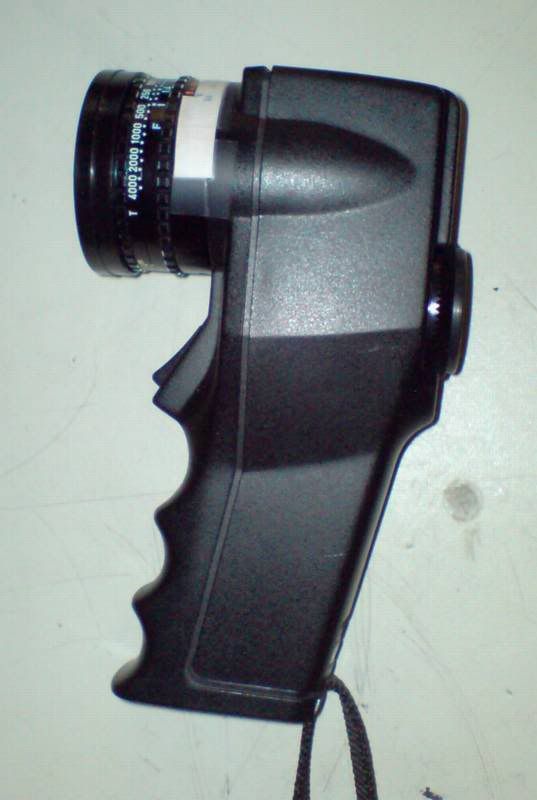
Since purchasing my medium format camera last year, I've been coming to grips with using a light meter. Given my limited budget, I've had to make do with a small Sekonic L-8 meter which, while it does the job, has a few limitations.
The main problems with this particular meter are that it is purely an averaging meter, and does not have the ability to take spot readings. It also tends to be a bit inaccurate at low light levels, as a number of under exposed photos can attest to. As a result, I've been on the lookout for a new light meter.
I finally found what I was after this week, and today I took delivery of the light meter shown in the photo above. It's a Pentax digital spot meter, as used by the likes of Ansell Adams. I was a bit worried about how easy it would be to use, but as it turns out, I worried needlessly.
Despite that fact that the meter did not come with a manual or any instructions, I had figured out how to use it within a few seconds. I'm now looking forward to getting out and using it, and hopefully I'll have fewer issues with incorrect light meter readings in future.
Monday, February 26, 2007
The FIne Art of Optical Printing
As i was talking to the Gentleman from my local Ciba Chrome lab he mentioned a very valid point.
Hardly any does optical printing anymore... and consequently those skills are disappearing.
I mean you take your film into your local 1 hour shop, it gets developed, scanned and printed. while the results are consistent there is no control or though... all values are evened out for an optimum result . Certainly this works for the mass consumer but sometimes i don't want the image razor sharp, or fully colour corrected etc etc. I really do believe that despite the advent of Digital mass produced consumerism , Black and white will survive not just as an artistic medium but as a way of exercising full control over an image to be able to demonstrate a form of self expression that just is not available with using a computer. A computer generated image is optimal and can be reproduced time and again...quality is only dependent on the the final print process and printers used etc. but by and large this is predictable. A Handmade print is unique as the operator is not perfect and even with following every step to the letter there will be minute variances. Can they be considered faults? well one can argue, but it's these little imperfections that make a print unique and one of a kind, so in light of that no, i would not call them 'imperfections' but rather 'fingerprints', as it were, or simply unique markers.
Hardly any does optical printing anymore... and consequently those skills are disappearing.
I mean you take your film into your local 1 hour shop, it gets developed, scanned and printed. while the results are consistent there is no control or though... all values are evened out for an optimum result . Certainly this works for the mass consumer but sometimes i don't want the image razor sharp, or fully colour corrected etc etc. I really do believe that despite the advent of Digital mass produced consumerism , Black and white will survive not just as an artistic medium but as a way of exercising full control over an image to be able to demonstrate a form of self expression that just is not available with using a computer. A computer generated image is optimal and can be reproduced time and again...quality is only dependent on the the final print process and printers used etc. but by and large this is predictable. A Handmade print is unique as the operator is not perfect and even with following every step to the letter there will be minute variances. Can they be considered faults? well one can argue, but it's these little imperfections that make a print unique and one of a kind, so in light of that no, i would not call them 'imperfections' but rather 'fingerprints', as it were, or simply unique markers.
Sunday, February 25, 2007
Well... now i've gon an' done it
I found an LPL enlarger on ebay(luv me e-bay).. put a bid in and won. picked up yesterday .
Wow.. it's a monster. 4 foot post to carry the enlarger... that makes for a pretty big enlargement or fairly close detail.
came with a Cibachrome control unit. However i 'm only using it for B&W so it will be more than adequate for my needs. now i've just got to set up me Darkroom.....
Wow.. it's a monster. 4 foot post to carry the enlarger... that makes for a pretty big enlargement or fairly close detail.
came with a Cibachrome control unit. However i 'm only using it for B&W so it will be more than adequate for my needs. now i've just got to set up me Darkroom.....
Saturday, February 24, 2007
Why Would You Make it Black and White?
This is a question that was posed to me recently, in a critique of my work. The photo in question (seen in this blog post) is one I have for sale on a stock photography site, which allows photos to be rated by other photographers. My initial reaction to the question was "Umm, because it was shot on black and white film, that's why".
The fact that the question was even asked at all got me thinking about the changes that have occured in photography over the years. I started to question whether I should be surprised that someone might not realise that a photo was taken using black and white film, given that using film at all seems to be unusual in itself. A quick browse of 10 random photos on the stock photography site was enlightening, not one of them had been taken using film.
It's been about 15 or 16 years since I first got really interested in photography, and it's interesting to think of those things which were normal back when I started, and which are now nothing more than the realm of professional photographers, or crazy hobbyist shutterbugs...
For example:
• Fifteen years ago, I'd never even heard of a digital camera, yet someone buying a camera today would not be able to buy a film camera new (assuming a consumer range camera).
• Fifteen years ago, it took a week to get a black and white film developed in my home town, these days, you can take your memory stick into your camera shop of choice, and get your prints straight away.
• Fifteen years ago, to be able to manipulate the photos you took meant you had to have access to a dark room. These days even the most basic, freely available graphics programs will let you play around with your photos to some extent.
Maybe it's not so surprising that people don't know about black and white film any more...
The fact that the question was even asked at all got me thinking about the changes that have occured in photography over the years. I started to question whether I should be surprised that someone might not realise that a photo was taken using black and white film, given that using film at all seems to be unusual in itself. A quick browse of 10 random photos on the stock photography site was enlightening, not one of them had been taken using film.
It's been about 15 or 16 years since I first got really interested in photography, and it's interesting to think of those things which were normal back when I started, and which are now nothing more than the realm of professional photographers, or crazy hobbyist shutterbugs...
For example:
• Fifteen years ago, I'd never even heard of a digital camera, yet someone buying a camera today would not be able to buy a film camera new (assuming a consumer range camera).
• Fifteen years ago, it took a week to get a black and white film developed in my home town, these days, you can take your memory stick into your camera shop of choice, and get your prints straight away.
• Fifteen years ago, to be able to manipulate the photos you took meant you had to have access to a dark room. These days even the most basic, freely available graphics programs will let you play around with your photos to some extent.
Maybe it's not so surprising that people don't know about black and white film any more...
Sunday, February 18, 2007
pic of the week 18/2/06

Well here is this weeks contribution .Iwas down at the Port today and i found an old barnacle encrusted timber support. This is one of the macro shots of a worm encrusting a Barnacle encrusting a Timber.
I will be going and revisiting the site as i think Black and White will work well.
Techy Details:
Pentax ist, AV Mode, F 16 under natural Light Diffused by heavy cloud cover.
Monday, February 12, 2007
Astral Travel....and other esoterics

One of the things that has occurred with the recent arrival and subsequent departure of Comet McNaught is that a friend of mine has stirred my interest in astrophotography. That in itself presents a challenge as the the light and movement of the earth are to be considered. The technical aspects can be quite daunting , ie specialised mounts,and film and patitience and good weather .. the list goes on.
however i managed to get attachd image with my Pentax *ist. 30 sec exposure at F4, at iso 400. And then tweaked a little in Photoshop to up the levels and ad reduce some of the noise.
Well.. i happen to find a second hand equatorial mount , attached to a 900 mm telescop(that was a bonus) and a motor drive will soon be attached so, long nights await yours truly.
Monday, January 29, 2007
AGFA Clack Oh how simple......yeah Right!!!!


Actually The clacks are simple. Point. Shoot.Develop.
As the cameras were designed to work around iso50 (and that appears to be getting harde/more expensive to get) i have been working with different film speeds. Most notably ISO100. one of the other problems/bonus i have in South Australia is Light. We have an inordinate amount of clar sunny days and sometimes there just is too much brightness(i know i know..can't please everyone) but what i have done is uploaded these three Shots all taken within seconds of each other. The Day was exceptionally bright almost no clouds. They were shot on Fuji Astia iso100 film. the filters used as follows
1. ND.8
2.ND.4
3.Skylight
It would appear that on most days i would have to use at a minimum the ND.8 filter to cope with the usual lighting conditions encountered.What should have(note to self. remember for future reference) I should have written down the readings of my Gossen Lightmeter......live and learn.
Tuesday, January 09, 2007
Japanese Garden Orchid

Well it's my turn for a pic of the week; trhe weekly photo may be a weekly or monthly or fortnitely post...i'll see how i feel.
This Orchid i found sitting in the local Japanese Gaeden. just a little fill flash. I liked the way the colours contrasted between the flower and the rock behind it.
Monday, January 08, 2007
Pic of the Week, 08/01/2007
Well, it's time for my second "Pic of the Week", and it's another photo from my last bushwalk. I was hoping to be able to post one of the photos that I'd taken with my M645, but unfortunately I'm still waiting for the film to be processed (a long story...).
The photo I've picked is still from that bushwalk, just taken with my digital camera.

This particular photo is a detail of a Cushion Plant, a kind of grassy plant found in alpine areas of Tasmania. They get their name because they look exactly like large green cushions. Despite the fact that they look quite sturdy, Cushion plants are in fact very sensitive to damage, and simply stepping on one is often enough to damage it.
The thing that caught my eye here was the lighter coloured plants sprinkled throughout this particular cushion plant. It's not uncommon for different species of cushion plant to grow together, but I've never seen any quite like this before.
The photo I've picked is still from that bushwalk, just taken with my digital camera.
This particular photo is a detail of a Cushion Plant, a kind of grassy plant found in alpine areas of Tasmania. They get their name because they look exactly like large green cushions. Despite the fact that they look quite sturdy, Cushion plants are in fact very sensitive to damage, and simply stepping on one is often enough to damage it.
The thing that caught my eye here was the lighter coloured plants sprinkled throughout this particular cushion plant. It's not uncommon for different species of cushion plant to grow together, but I've never seen any quite like this before.
Monday, January 01, 2007
A New Year Beckons...
Well, I've just seen in the new year in the best way I can imagine, 4 days of bushwalking, and taking photos. One of the many things I've decided I am going to do more of this year is get out and take photos. The last few days have been a very good start, having taken about 80 photos between my digital and medium format cameras.
It's been pointed out that for a blog about photography there are very few photos being posted here. In an attempt to rectify this situation, and to encourage me to take more photos in the first place, I've decided to post a "Photo of the Week". I'll be posting (or at least trying to post) one of my photos here each week.

To get things rolling, I'll start with a photo taken only 2 days ago while bushwalking. This is one of those photos which just happened by accident. I'd camped near some small pools of water, and I happened to notice that the nearby pencil pines had shed their needles into the lakes, and had created some interesting patterns.
Unfortunately the reflection of the sun was causing problems, and in order to see the detail I needed a polarising filter to cut out the reflections from the water, something which I did not have. Purely by accident, I noticed that one of the pencil pines was shading the water in such a way that the patterns and colours were clearly visible in its shadow. So, purely by chance, I ended up with the photo I wanted, being the detail of the pine needles in the water, with the added bonus of an interesting reflection from the pine tree itself. If only all photos were as easy to come by as this...
It's been pointed out that for a blog about photography there are very few photos being posted here. In an attempt to rectify this situation, and to encourage me to take more photos in the first place, I've decided to post a "Photo of the Week". I'll be posting (or at least trying to post) one of my photos here each week.
To get things rolling, I'll start with a photo taken only 2 days ago while bushwalking. This is one of those photos which just happened by accident. I'd camped near some small pools of water, and I happened to notice that the nearby pencil pines had shed their needles into the lakes, and had created some interesting patterns.
Unfortunately the reflection of the sun was causing problems, and in order to see the detail I needed a polarising filter to cut out the reflections from the water, something which I did not have. Purely by accident, I noticed that one of the pencil pines was shading the water in such a way that the patterns and colours were clearly visible in its shadow. So, purely by chance, I ended up with the photo I wanted, being the detail of the pine needles in the water, with the added bonus of an interesting reflection from the pine tree itself. If only all photos were as easy to come by as this...
Lets bring some Colour to these Monochromatic Proceedings
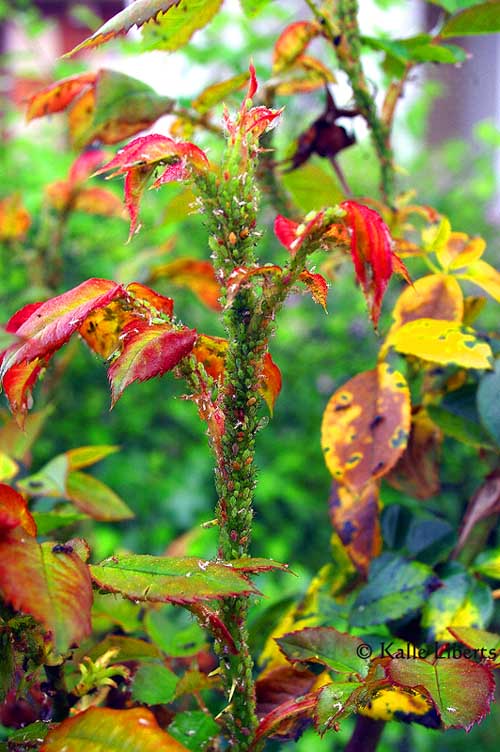
I've been thinking of uploading this image for some time now but never had the excuse to do so... but here it is
My roses were infected with Aphids and so i took the opportunity to try out my new Intensifier filter that arrived funnily enough that very morning(Hoya 58mm Dydimium Filter---great filter, should be in every kit)
yhe image is only slightly tweaked in photoshop ie sharpened and levels balanced. the rich reds/yellowsbrowns are intensifed by use of aforesaid filter
I've come to the conclusion that the use of filters should be judicious and applied selectively(in the case of the effects filter) as one can end up trapping one self in cliche pictures.
My Current philosophy on filters (with exception of UV/C-PL/Intesifying and other necessary filter 81a,80a etcetc) they should used like Pesticides- as often as is necessary but as little as possible
Monday, December 18, 2006
Splendiferous images
I friendly reader kindly Pointed out that , seeing this a Photography Blog there is a distinct lack of , well, Photos!
This is something we shall remedy in future postings..so in the words of Tom Lehrer; Be Prepared...!
This is something we shall remedy in future postings..so in the words of Tom Lehrer; Be Prepared...!
Sunday, December 17, 2006
Depth of Field
One of the more challenging concepts to get right in my own mind were the principles of depth of field.
as far as light fitting the film is concerned it's swings and roundabouts.
I.e. a given large aperture and fast speed is the equivalent of a given small aperture and slow speed, as long as the same amount of light hits the film it will be exposed to the same degre(more or less)
DoF is a concept that i read and read about but did not grasp until i did a test shoot
and then things all fell into place
I guess it's something that one has to see and and get a feel for in a hands on approach otherwise all the theory becomes just words on paper
Once i develop the B&W studies that i did today i think i will a have a clearer and simpler comprehension of DoF
as far as light fitting the film is concerned it's swings and roundabouts.
I.e. a given large aperture and fast speed is the equivalent of a given small aperture and slow speed, as long as the same amount of light hits the film it will be exposed to the same degre(more or less)
DoF is a concept that i read and read about but did not grasp until i did a test shoot
and then things all fell into place
I guess it's something that one has to see and and get a feel for in a hands on approach otherwise all the theory becomes just words on paper
Once i develop the B&W studies that i did today i think i will a have a clearer and simpler comprehension of DoF
Saturday, December 02, 2006
I've got the Clack...
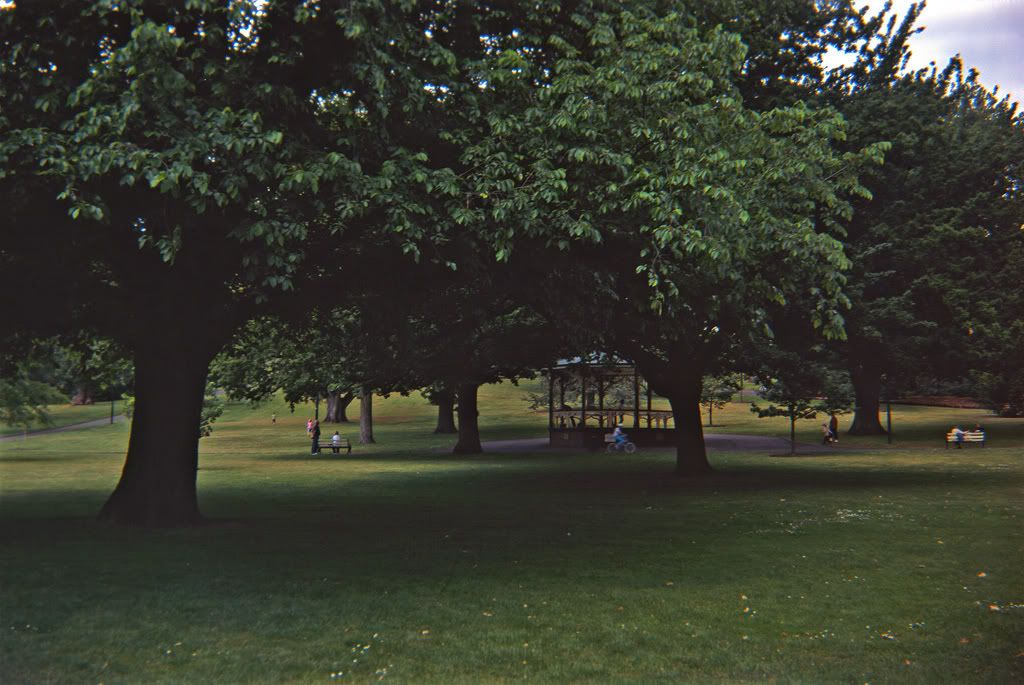
No, I don't have some exotic disease, but I do have a rather peculiar addiction to the latest addition to my collection of cameras, an Agfa Clack (see this post about the Clack). To look at, the Clack's not a very sophisticated camera, it's got a fixed shutter speed, a choice of 2 apertures or a close up lens. It's also about 40-50 years old. But for all that, it's a neat little camera to use.
I'm just in the process of scanning in the first roll of film I took with it. All in all, it hasn't turned out too bad. I've had some issues with getting exposures right, as the Clack was designed to be used with 50 iso film, and I only have 100 iso. In theory a neutral density filter would fix that problem up, but the filter I've experimented with is apparently a 2 stop filter, where I need a 1 stop filter. Still, there are ways around that, too...
Monday, November 20, 2006
..and a camera for all occasions
hmm ... yes i fing it a little heavy as well, carrying all the gear around that one seems to accumulate and one deems necessary.I guess there is a thing as too much choice. Now , i also have incluided in my gear that i normally carry also a nifty little rangefinder Retina II camera, which in itself is an antique but one that still shoots images of good quality. so all in all i still enjoy woking with the different media( 120,35mm, digital) but as the dear lady wife said'yer going to have to get a bigger bag.....or carry less gear...! wise words, methinks
Monday, November 13, 2006
A camera for all seasons...
Last week I went bushwalking, and as I am wont to do, I took my camera along. This was my first bushwalk carrying my medium format camera and my Manfrotto 190V tripod. I also took along my little point-and-shoot digital camera, and boy am I glad I did.
Now, the Mamiya 645 is a wonderful camera, and the Manfrotto 190 is a great tripod, but together, they're bloody heavy, and somewhat slow to set up. Which means they're not suited to grabbing a quick photo while walking along. The digital is another story, though.
Kept in a little waterproof bag hanging from my pack straps, the camera was always handy, and didn't require me to take my pack off if I wanted to grab a photo. So, my conclusion: The combination of medium format camera for taking photos in the morning or evening, and the digital for taking photos while walking was ideal. All I need to do now is get fitter so my pack doesn't seem so damn heavy...
Now, the Mamiya 645 is a wonderful camera, and the Manfrotto 190 is a great tripod, but together, they're bloody heavy, and somewhat slow to set up. Which means they're not suited to grabbing a quick photo while walking along. The digital is another story, though.
Kept in a little waterproof bag hanging from my pack straps, the camera was always handy, and didn't require me to take my pack off if I wanted to grab a photo. So, my conclusion: The combination of medium format camera for taking photos in the morning or evening, and the digital for taking photos while walking was ideal. All I need to do now is get fitter so my pack doesn't seem so damn heavy...
Subscribe to:
Posts (Atom)